Marketing Mix Modeling
A Study of Confounding and Experimental Calibration
Independent Research - University of Tennessee
Bayesian MMM, Causal Inference, PyMC-Marketing, Synthetic Data
Can We Trust Marketing ROI?
A synthetic-data study testing whether observational Marketing Mix Modeling can recover true causal ROI, and what it takes to make it trustworthy when it can't.
Supervisor: Dr. Russell Zaretzki (Heath Faculty Fellow, Business Analytics & Statistics; Haslam College of Business, University of Tennessee, Knoxville, USA)
Additional Resources: Paper (Document) · Git Repository
Marketing Mix Modeling (MMM) is widely used to allocate media budgets, but it relies on observational data; leaving it vulnerable to confounding from organic demand, ad-targeting mechanisms, and macroeconomic trends. Measuring the true return on ad spend is a notoriously hard problem (Lewis & Rao, 2015): randomized lift tests isolate the causal effect cleanly but are too expensive and slow to run continuously (Gordon et al., 2019), while MMM evaluates all channels at once from historical data but faces well-documented identification challenges of its own (Chan & Perry, 2017). This project asks a direct question: can an observational MMM be trusted to recover causal ROI, and if not, what does it actually take to make it trustworthy?
I don't propose new estimation methodology here. The Bayesian MMM builds on classic market-response modeling (Hanssens et al., 2001) and Bayesian media-mix formulations with adstock and saturation effects (Jin et al., 2017); the backdoor-adjustment framework follows standard causal-DAG theory (Neuberg, 2003) (Hernán & Robins, 2020); and the calibration-via-prior technique follows Zhang et al.'s approach to combining MMM with experimental lift tests (Zhang et al., 2024). The contribution is empirical: using synthetic data with known ground truth, I show concretely when these established methods succeed, when they fail, and what it takes to correct them, then validate the same failure pattern on a real, public dataset.
Three questions, one synthetic dataset
Because the ground-truth ROI is known by construction in synthetic data, estimation accuracy and bias can be measured directly rather than assumed.
Recovery
When the truth is known, do the model's posteriors actually cover the true ROI?
Confounding
How much does omitting a demand confounder bias ROI, and does adjusting for it fix the bias?
Calibration
Can an experimental lift estimate, injected as a prior, correct an MMM that observational data alone gets wrong?
A four-stage experimental design
Every stage keeps the same Bayesian model, priors, adstock, saturation, seasonality, and sampler settings; so differences in results come from the data and controls, not from changing the model.
Parameter Recovery
Fit a naive OLS, an oracle OLS with known transforms, and a full Bayesian MMM on clean synthetic data where spend is assigned independently of demand; the best-case scenario for any observational method.
Confounding & Backdoor Adjustment
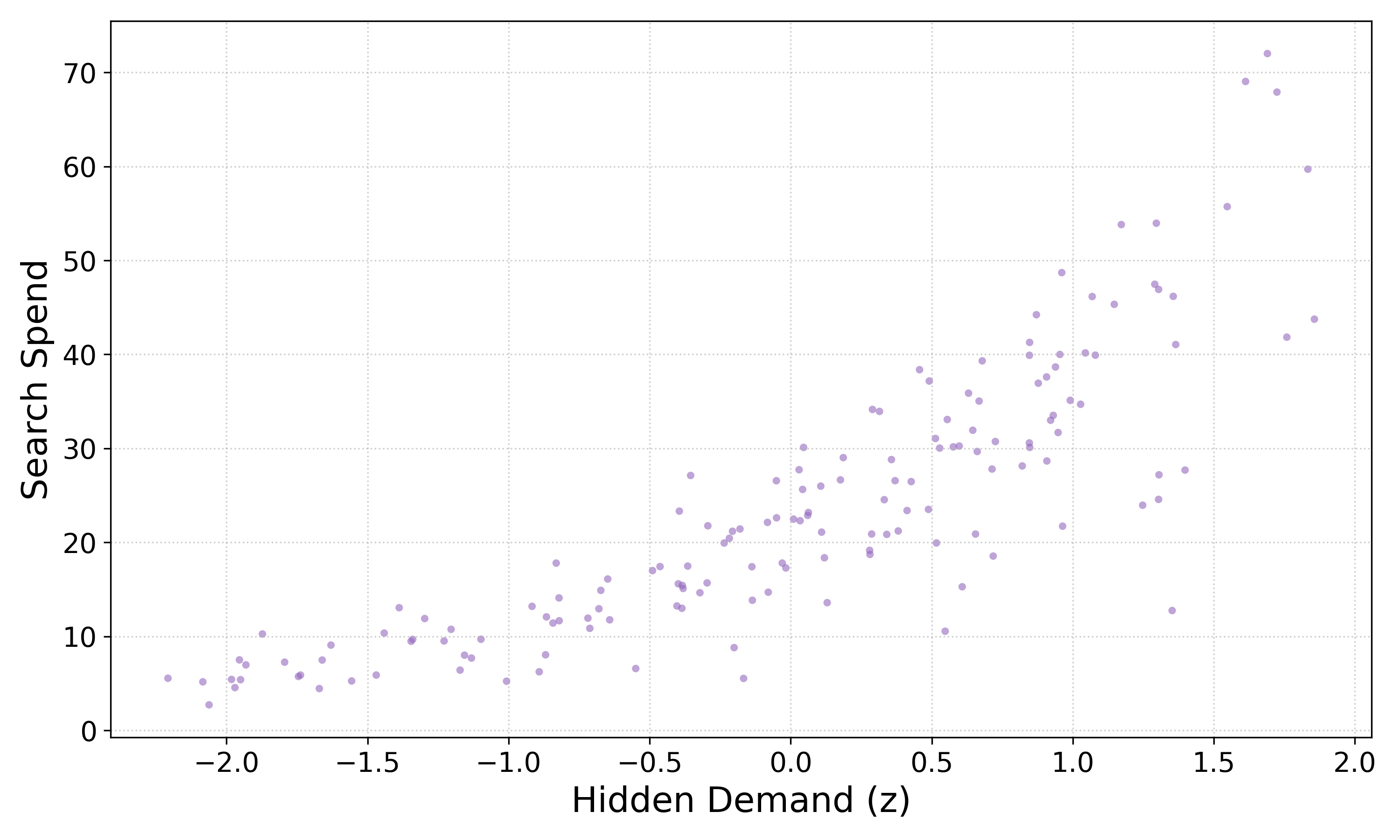
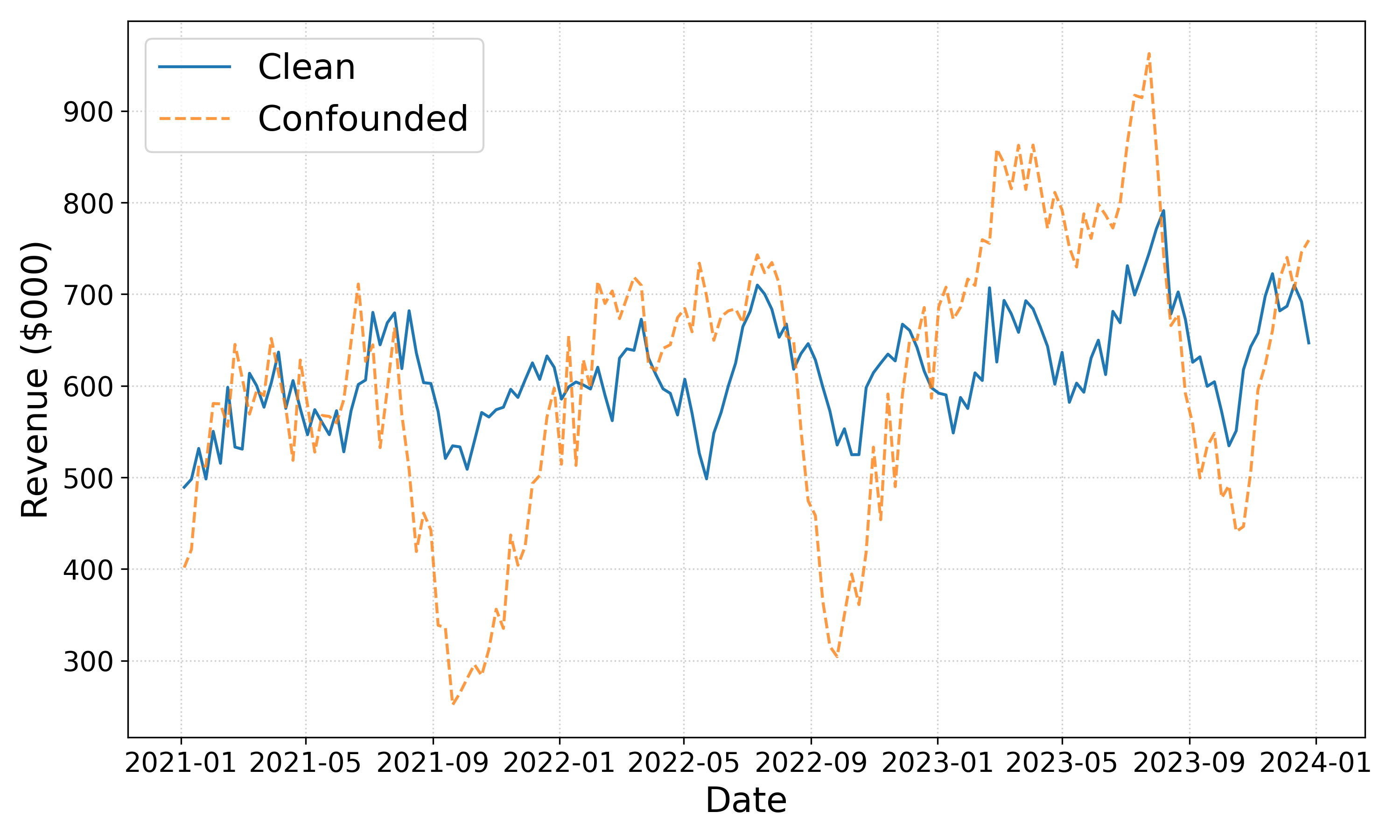
Introduce a latent demand confounder that drives both spend and revenue. Fit the same model with the confounder uncontrolled (backdoor open) and controlled (backdoor closed), then compare.
Experimental Calibration
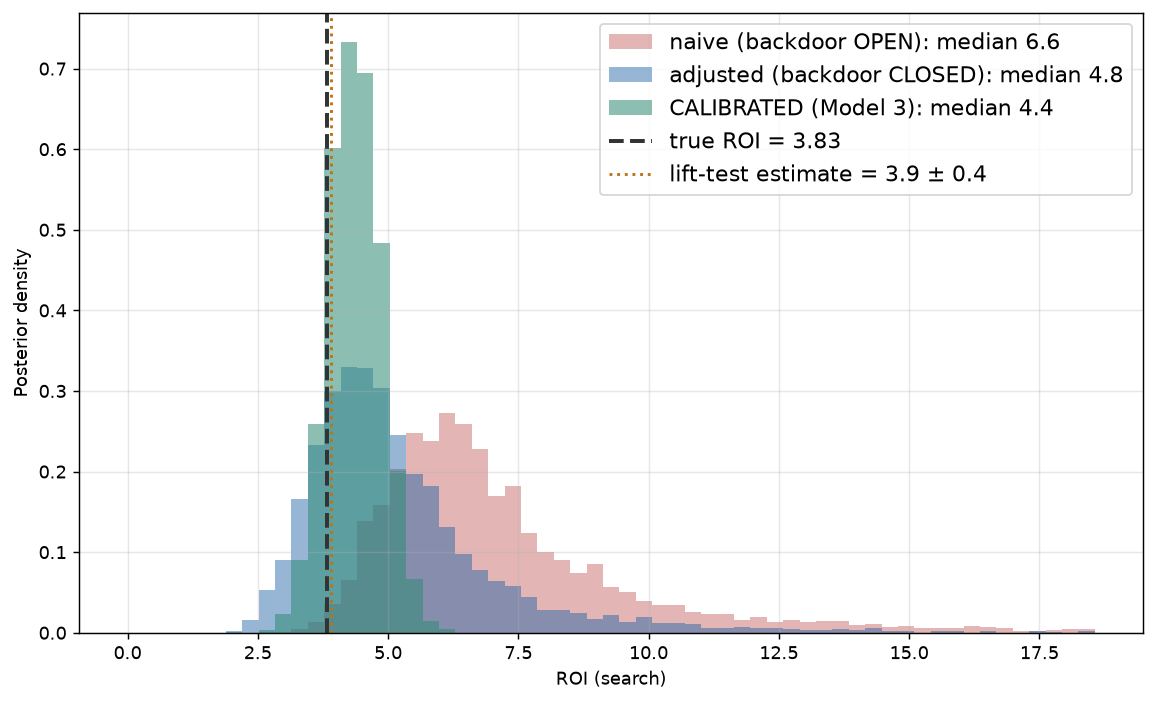
Simulate a randomized geo-lift test (Sun et al., 2017) on one channel and inject its ROI estimate as an informative prior, following Zhang et al.'s calibration approach (Zhang et al., 2024); while leaving the demand confounder unmeasured and the backdoor open.
Real-World Validation
Refit the Bayesian MMM on Meta's public Robyn dataset (208 weeks, five channels), with and without a competitor-sales control, to check whether the synthetic failure pattern replicates on real data.
Built with
What each stage found
Four stages, from the best-case scenario to a real, uncontrolled dataset.
Can a Bayesian MMM recover true ROI with no confounding at all?
Media spend was assigned independently of demand, so the backdoor path doesn't exist; the most favorable setting possible for an observational method.
Solution
Yes. Every channel's true ROI fell inside the model's 95% credible interval, with 94.2% of weeks inside the 90% predictive interval (predictive R² = 0.91). But low-spend channels like Email and Display carried very wide intervals: accurate coverage, low precision.
How much does an unmeasured demand confounder distort ROI, and does adjustment fix it?
A latent demand signal was wired into both spend and revenue, opening a backdoor path. The model was fit with and without a control for it.
Solution
Search's ROI was overestimated by +2.74 with the backdoor open, dropping to +0.97 once adjusted, adjustment worked well here. Email was worse (+7.99 → +5.72) despite the weakest demand link; its bias was mostly pre-existing model weakness, not confounding, so adjustment alone couldn't fix it.
Without an observable confounder to adjust for, can one experiment still correct the model?
A simulated geo-lift test on Search (ROI = 3.9 ± 0.4) was injected as an informative prior, with the demand confounder left unmeasured and the backdoor open the entire time.
Solution
Search's median ROI shrank from 6.57 (naive) to 4.35 (calibrated), with the credible interval tightening to [3.37, 5.36]. The fix was channel-specific though; Email, left uncalibrated, stayed inflated at 11.66.
Does the same confounding pattern show up outside synthetic data?
The Bayesian MMM was refit on Meta's public Robyn dataset (208 weeks, five channels), once with a competitor-sales control and once without it.
Solution
Dropping the confounder inflated Search ROI by +73.3% and Facebook by +32.6%, while upper-funnel channels like TV and Print moved the opposite direction; the exact signature seen in the synthetic experiment, confirmed without ever knowing the real ground truth.
Navigating real-world deployment requires a unified approach: combining observational MMM with randomized lift testing to get causally robust ROI estimates. Neither approach alone is enough; observational data is scalable but confounded, and experiments are unbiased but too expensive to run for every channel.
Figures
References
2024
- Media mix model calibration with Bayesian priors2024
2020
- Causal Inference: What If Chapman & HallCRC, Boca Raton, 2020
2019
- A comparison of approaches to advertising measurement: Evidence from big field experiments at FacebookMarketing Science, 2019
2017
- Challenges and opportunities in media mix modelingGoogle Inc, 2017
- Bayesian methods for media mix modeling with carryover and shape effectsGoogle Research, 2017
- Geo-level bayesian hierarchical media mix modelingURL: https://ai. google/research/pubs/pub46000, 2017
2015
- The unfavorable economics of measuring the returns to advertisingThe Quarterly Journal of Economics, 2015
2003
- Causality: models, reasoning, and inference, by judea pearl, cambridge university press, 2000Econometric Theory, 2003
2001
- Market response models: Econometric and time series analysis2001